


Sound is nothing else than small pressure fluctuations, of which the
frequency and wavelength are related such that they can propagate through
the air (with the speed of sound). In other words, the sound that we hear
can be interpreted as pressure waves. The role of pressure fluctuations is
for instance clear in the definition of the sound level which is defined as

 is the so-called sound pressure level measured in decibels
(dB),
is the so-called sound pressure level measured in decibels
(dB),  is the root mean square of the fluctuating pressure and
  is a reference pressure level which depends on the medium. In air
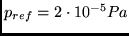 . A pressure signal with a rms of
  , which is
very small compared to the atmospheric pressure
, which is
very small compared to the atmospheric pressure
 , gives a
SPL of
, gives a
SPL of  which is very loud for most humans.
Sound can be beneficial, e.g. speech or music, but it can also be burden. It is with this latter type of sound, also denoted as noise, that we shall occupy ourselves here. Our society demands that the noise levels produced by various engineering applications, (engines), transport vehicles (trains,trucks), household appliances (vacuum-cleaner, hairdryer) are as low as possible. For their design numerical tools are necessary, which can give a reasonable accurate sound prediction and which allow us to develop and test methods to reduce noise.
In this proposal we will restrict ourselves to the production of sound by a flow. It is a well-known fact that at sufficiently high flow velocities, in particular at flow conditions for which turbulence occurs, fluid motions can generate sound. This type of sound production is studied in the field of aeroacoustics, which is considered to be a branch of fluid mechanics. Although aeroacoustics has been studied for about fifty years, there are nevertheless a lot of open questions on how to determine the acoustic field from a solution of the fluid mechanics equations. The most important issues are: Reynolds number effects, formulation of boundary conditions, source convection and the refraction of sound by (local) temperature gradients. Some other issues are the effect of density differences in the background flow, effect of the Mach number, etc.
During the last years I have worked on the numerical prediction of noise generated by turbulent flows. In that work several computational methods have been tested and some of the results will be given in the next section. These simulations have been carried out at a rather low Reynolds number and high Mach number while many of the applications of flow noise occur at large Reynolds numbers and a moderate Mach numbers, see e.g. the examples mentioned in the abstract. Therefore one of the aims of this proposal is to extend the existing simulation methods to the prediction of sound sources in practical flows, i.e. at large Reynolds numbers and at the same time at rather low Mach numbers. This will require some modelling assumptions and approximations, which will be described in more detail in the next sections. However, the necessity of such approximations and assumptions requires a careful experimental validation of the simulation results.1 As a first step the simulations at low Reynolds numbers, i.e. computations without any modelling assumptions, need to be checked. Only when these simulations prove to be accurate we are confident enough to extend our simulation methods to higher Reynolds numbers. In other words experiments are needed which cover a large range of Reynolds numbers and possible also of Mach numbers.
All existing experiments, which are reported in the literature and which present acoustic data, have been performed at high Reynolds numbers. Furthermore, most of these experiments have fairly high Mach numbers, which can give rise to additional noise sources, for instance noise associated with shock waves. Therefore, in addition to the numerical simulations we plan to build an experimental setup, in which we can measure flow and flow noise at low Mach numbers and for a large range of Reynolds numbers. This should include Reynolds numbers for which we can simulate the flow without any modelling assumptions up to the Reynolds numbers, which are reached in practical flow situations. Our aim is to perform these measurements without changing the physical dimensions of the setup or the measurement hardware so that any bias in the experimental results due to changing the experimental environment is avoided. With this experimental setup we can obtain experimental data which can be used to validate present and to-be-developed numerical models for the prediction of flow noise.